
How Natural Gas Saved Texas From the Cold, Again
Thu, February 05, 2026
Winter Storm Fern tested Texas’ power grid for the first time since 2021 and natural gas delivered. Record-setting temperature drops across the Lone Star State and most of the country drove higher energy demand, placing added strain on gas distribution and the power grid.
But Texas’ natural gas industry was prepared to weather the storm. Here’s a look at how the state relied on natural gas to keep the lights on.
Natural Gas Kept the Lights On
The Electric Reliability Council of Texas (ERCOT) made it through the storm without issuing an Energy Emergency Alert, without asking Texans to conserve power, and without any systemwide outages.
As colder temperatures began to set in, the grid operator relied on dispatchable generation to stop blackouts. Natural gas was the sole fuel source that was able to ramp up quickly to support this demand, providing steady electricity when winter conditions prevented wind and solar generation.
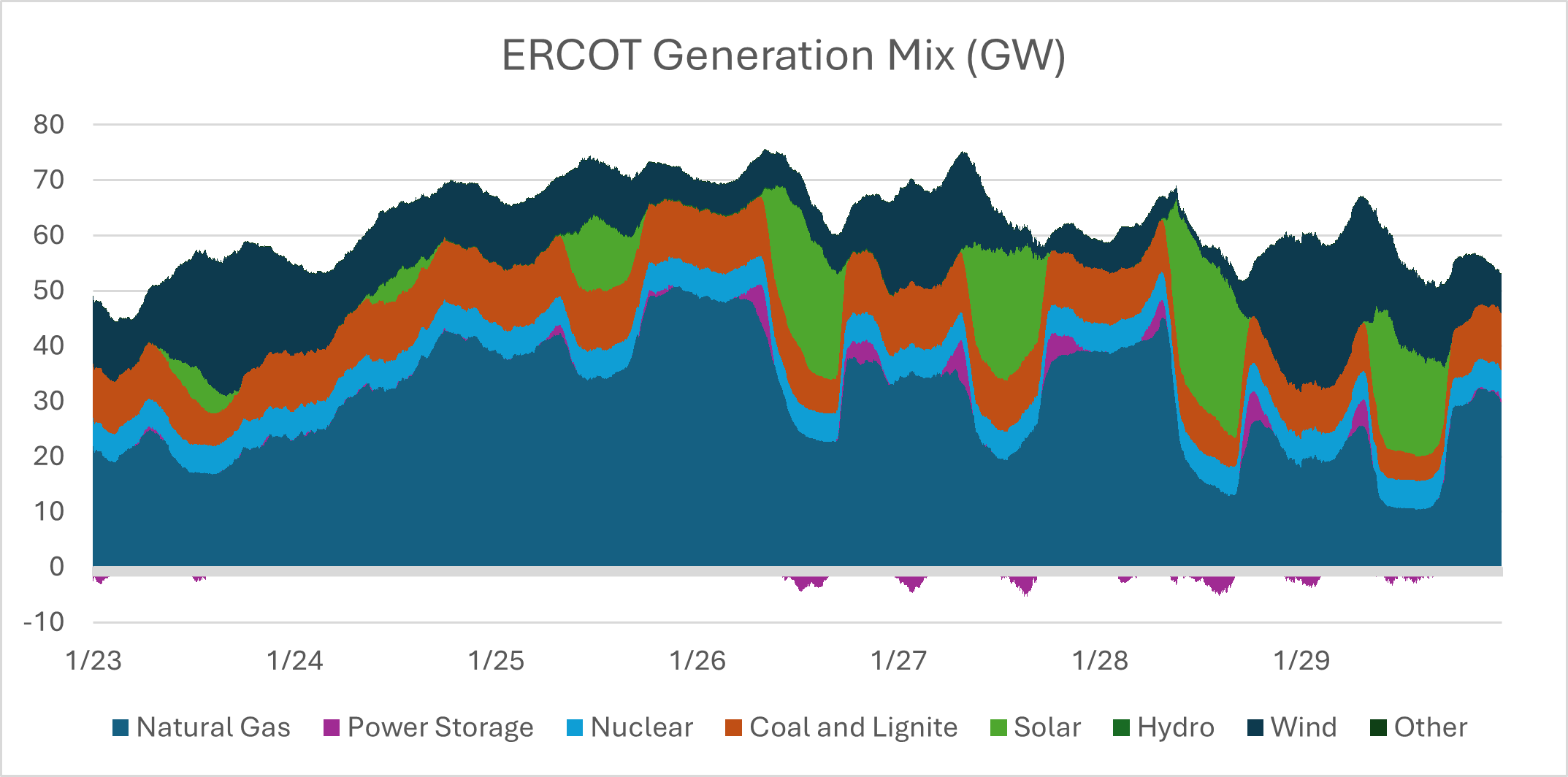
Source: ERCOT data collected via GridStatus.io
At its peak, 70 percent of Texas’ electricity generation was coming from natural gas and remained the largest source of electricity for Texans, especially during the storm’s coldest nights.
When power outages did happen, they were due to issues with local utility distribution, like local power lines, not the gas-fired generators that supply electricity. While Wood Mackenzie identified twelve individual trips on the ERCOT grid within 48 hours of Winter Storm Uri hitting in 2021, there was only one trip in that same timespan after Fern.
As Stephen Ryan, a Wood Mackenzie power market analyst pointed out, “The gas, coal and nuclear fleet was all significantly more reliable this time around. More resources successfully remained online when the grid needed them to.”
How Texas Prepared
In the aftermath of Winter Storm Uri, state regulators and local industry took meaningful steps to strengthen the resiliency of natural gas during extreme weather events. From passing legislation to implement more stringent weatherization standards for energy generation to prioritizing winterization of natural gas facilities, Texans can be assured their grid is more resilient than it has ever been.
A 2022 Texans for Natural Gas report outlining the lessons learned from Uri highlights the results of this work. For example, approximately 98 percent of natural gas facilities in Texas, including generation and transition assets, successfully passed updated winterization inspections conducted by ERCOT and the Public Utility Commission of Texas.
“Texas’ natural gas industry has invested heavily in winterization techniques and other preparations for extreme weather events over the past 15 years, with major advancements following the 2011 freeze and Winter Storm Uri in 2021,” said Ed Longanecker, President of the Texas Independent Producers and Royalty Owners Association. “Targeted investments in weatherization, such as insulation, line heaters, and proactive site evaluations, alongside workforce training, continued growth in natural gas resources, and state-level reforms have put Texans in a stronger position, one that is equipped to handle extreme weather conditions.”
Record-high gas production in 2025 also played an important role in meeting the demand. Gas storage played an increasingly important role in ensuring that Texas and the rest of the country had enough gas to weather the storm.
Michael Webber, an energy professor at the University of Texas, noted that winterization efforts helped to ensure the grid stayed online during Winter Storm Fern and that Texas is not much more resilient towards winter weather.
The natural gas industry is continuously learning from past winter storms and has worked tirelessly with Texas officials, regulators, and experts over the last five years to provide more reliable gas to heat homes and generate electricity. But the work doesn’t stop here. Texas’s natural gas industry is constantly improving, innovating, and investing in new solutions to power the grid and heat homes across Texas and beyond.
