
World Bank: U.S. Flaring Falls with Texas Leading the Way
Mon, July 06, 2026
The World Bank’s latest Global Gas Flaring Tracker Report revealed the U.S. had the largest flaring reductions of any country. The data is an important recognition of U.S. progress in reducing emissions at a time when global flaring rose for a third straight year in 2025.
The report shows the United States cut flaring while increasing oil production, a meaningful reinforcement of what American producers have said for years: reducing flaring does not require reducing energy production. As Demetrios Papathanasiou, World Bank Group Global Director for Energy, noted, “The gas currently flared could be captured to power industries and businesses, create jobs, and strengthen energy security.”
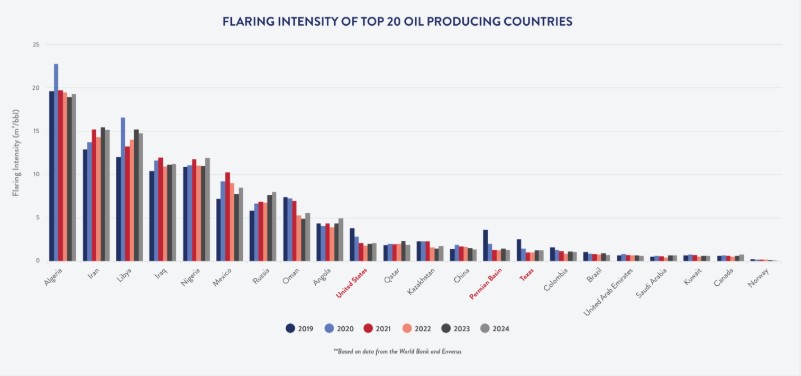
Source: World Bank 2024 Flaring Data
That national progress is also a Texas story. Our 2024 flaring report showed that Texas and the Permian Basin have been the leading examples of how production growth and environmental progress can move together. Between 2019 and 2024, Texas cut flaring intensity by nearly 50 percent, while production grew 12 percent, propelling the Lone Star State to surpassing 2 billion barrels of oil for the first time in its history in 2024.
In the Permian Basin, the results are even more significant: production rose 45 percent while flaring intensity dropped 62 percent. Between 2023 and 2024 alone, flaring volumes fell 4 percent in the region thanks to additional pipeline takeaway capacity coming online. This additional infrastructure was key to not only reducing flaring, but transporting energy safely and efficiently.

Source: Texans for Natural Gas
These results are the product of Texas innovation, environmental stewardship and investment in infrastructure. Pipeline projects and expansions such as Matterhorn Express, Gulf Coast Express, Permian Highway Pipeline, and Gray Oak helped expand takeaway capacity, relieve bottlenecks, and put more Texas natural gas to work for consumers. As our report emphasizes, “strong energy production and responsible operations go hand in hand.”
The bottom line: The World Bank data is a clear win for the United States, and Texas operators and producers have been the engine behind that progress. Texas oil and natural gas producers are delivering the energy Americans, and key allies around the world, need while maintaining their commitment to care for the environment and our communities. The World Bank’s data is also a clear signal to policymakers at the local, state and national level: more infrastructure, predictable permitting and continued production is key to keeping energy affordable, reliable and secure.
